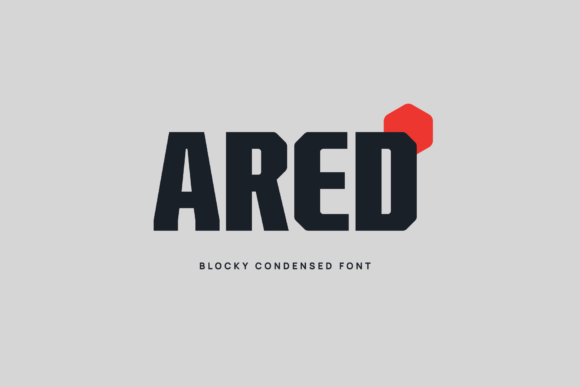
Ared: Bold Display Font for Handmade Labels & Craft Projects
If you’ve ever spent hours tweaking a label design only to realize the font lacks presence—or worse, gets lost on a candle jar or kraft tag—you know how much weight the right typeface carries. That’s why Ared stands out in my studio: it’s not just another display font. It’s a condensed, blocky, industrial-inspired typeface built for impact—without sacrificing clarity or craft-ready versatility.
Ared’s visual personality is unmistakable: sharp angles, tightly spaced letters, and subtle hexagonal geometry that echo tooling, signage, and modern fabrication. It feels grounded, confident, and intentional—not flashy, but fiercely present. As a maker who prints hundreds of labels, cuts vinyl for mugs and tote bags, and designs printable wedding suites, I need fonts that hold up at 8mm tall on a sticker *and* command attention at 24 inches on a farmhouse sign. Ared does both.
For physical product labeling—think soy candles, small-batch soaps, or ceramic mugs—Ared delivers instant brand cohesion. Its condensed width fits neatly on narrow jars or tags without shrinking letterforms into illegibility. I’ve used it for “Small Batch • Hand-Poured” on apothecary-style candle labels, and even at 10pt on matte sticker paper, the strokes remain crisp and legible under natural light and shop lighting. No fuzzy edges, no awkward gaps—just clean, assertive typography that tells customers your product means business.
Stickers and die-cut decals are where Ared truly shines. Whether it’s a bold “YES.” on a planner sticker sheet or “GIRLS NIGHT” cut from black vinyl for a party banner, its blocky structure ensures smooth cutting on Cricut and Silhouette machines. Unlike some aggressive display fonts with ultra-thin terminals or fragile serifs, Ared’s uniform stroke weight and open counters prevent snags, breakage, or pixelation in SVG exports. I’ve run it through three different blade types—and every time, it cut cleanly, even on 3-inch-wide adhesive vinyl.
Wedding and event creators will appreciate how Ared balances modern edge with timeless readability. Use it for welcome signs (“WELCOME TO THE WEDDING OF JEN & LEO”), escort cards, or foil-stamped menu headers. Its strong silhouette reads instantly from across a room, yet doesn’t overwhelm delicate florals or linen textures. Pair it with a soft, flowing script (like a relaxed brush script) for names, then drop Ared in for headings—it creates rhythm without competition. For seasonal collections, I’ve paired Ared with a clean, low-contrast sans serif for body text on holiday gift tags—“Handmade with Love • 2024”—and the contrast feels intentional, not accidental.
Printable designers and digital download sellers benefit from Ared’s consistency across formats. Whether embedded in a Canva template, exported as a high-res PNG for mockups, or layered into an Illustrator SVG for sublimation transfers, it retains its character. Its boldness translates well to screen previews—customers scrolling Etsy listings instantly recognize the premium feel of Ared-driven designs. And because it’s designed as a display font—not meant for long paragraphs—it keeps your focus where it belongs: on titles, quotes, and key phrases that sell your product.
Readability matters most when scaling down. On 1-inch round stickers, Ared works best for 2–4 word phrases (“BREW • SERVE • ENJOY”) or single words like “SPOON”, “FRESH”, or “LOCAL”. Avoid using it below 9pt for body copy—but that’s not its job. Let it do what it does best: anchor, emphasize, and define.
Font pairing is intuitive. Try Ared with a warm, organic serif like Playfair Display for invitation suites, or a minimalist geometric sans like Inter for packaging labels where clarity trumps ornament. If you’re designing social media graphics or web banners for your shop, Ared adds authority beside friendly handwritten fonts—say, for a “NEW ARRIVAL” banner over a photo of hand-dyed scarves. The contrast builds visual hierarchy while keeping your brand voice cohesive.
Ared comes with standard OpenType features—including stylistic alternates and basic ligatures—that let you fine-tune spacing or swap in sharper corners for specific words. It supports Latin-based languages and includes both OTF and WOFF files, making it flexible for print and web use. Always verify multilingual support if you serve global markets, but for English-first shops (especially those selling physical goods in the US, CA, UK, or AU), it covers all common needs.
Crucially, Ared is a commercial font with a clear license—meaning you can confidently use it in templates, digital downloads, SVG files, printed stationery, and merchandise you sell. Just double-check the license terms before bundling it into editable Canva templates or reselling font files themselves. When in doubt, use it *in* your designs—not *as* your design asset.
Whether you’re laser-engraving wooden coasters, printing boutique hang tags, or designing a limited-run planner cover, Ared gives your work visual weight and quiet confidence. It doesn’t shout to be seen—it simply *is* seen. And in a crowded handmade marketplace, that kind of quiet strength? That’s the kind of detail that turns browsers into buyers, and one-time shoppers into repeat customers.